
Appearance
Competitors carrying two cards
Audience: Timing operators at the download desk, and organisers deciding how a two-card event should run.
Some runners carry two cards and punch both at every control, so that a card that fails or falls off doesn't cost them their run. It's common at championships and elite races. meshO treats both cards as theirs: either card, or both, can be read, and the result comes from whatever was read.
The whole job
- Before they run, record the second card on the competitor: in Edit competitor, click the small card button beside Card number, type the second card's number and Save.
- When they come back, read their first card. Read the second card only if the first is a Missing punch.
- Check the result. There's nothing to assign: every read goes to the runner, and the result is worked out from both cards.
That's it for almost every runner. The rest of this page shows what you'll see in each situation, and what to do when one comes up.
Recording the second card
Open the competitor from the competitor list, the dashboard or the download page. Beside Card number is a small card button, greyed out while there is no second card. Click it, type the number, and click Save.
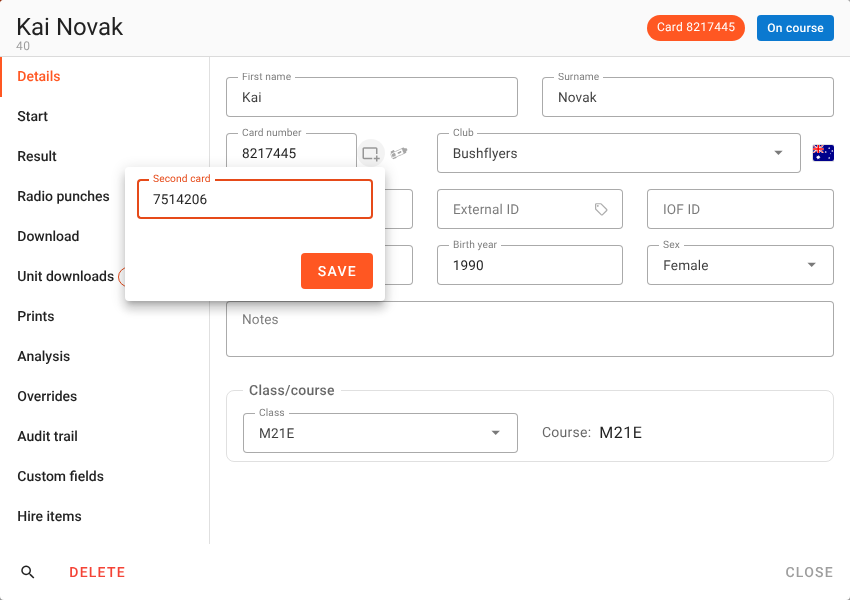
Once saved, the button is filled in, its tooltip names the second card, and the header reads Card 8217445 + 7514206.
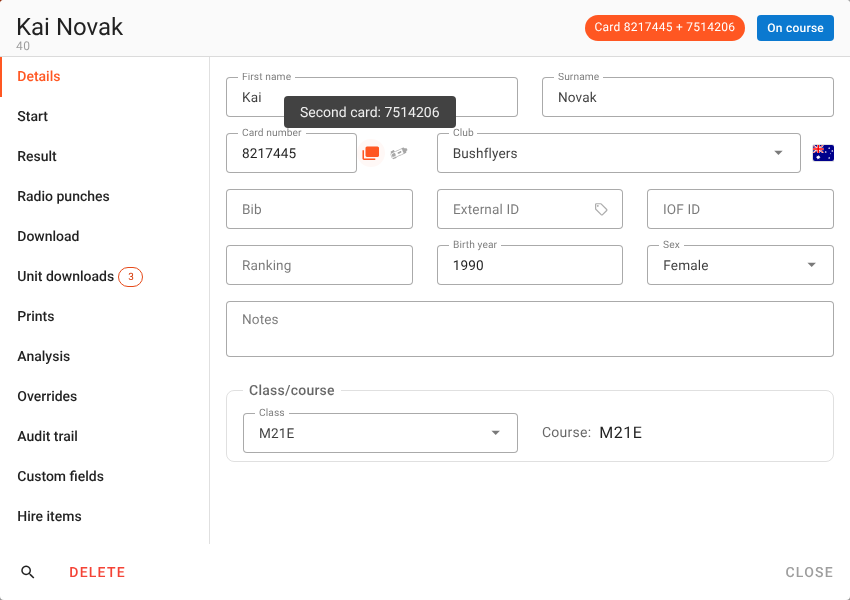
What to do: nothing more. If the runner is in Settings → Competitors, record the second card there too, and it comes with them into every event they enter.
meshO refuses a second card that's the same as their first, or that another entry already holds.
What each situation looks like
| They bring back | What you see | Result |
|---|---|---|
| Both cards, both fine | Two reads, both theirs | OK, on the first card's times |
| Both cards, the first failed partway | The first read is a Missing punch; the second turns it OK | OK |
| Only the second card | One read, theirs | OK, on the second card's times |
| Both cards, each missed a different control | Each read alone is a Missing punch | OK by default (see Choosing how the result is worked out) |
| Both cards, both missed the same control | Both reads are a Missing punch | Missing punch: they really did miss it |
The sections below go through them one at a time.
The first card failed partway round
Kai Novak's first card stopped recording partway round: it has controls 100 and 31, and nothing after. Read on its own, it's a Missing punch:
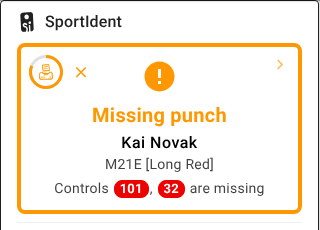
What to do: nothing yet. A mis-punch that ends in an unbroken run of missing controls looks like a failed card, not a wrong turn. Ask whether they carried a second card, and read it.
Kai's second card has every control. The moment it's read, the panel turns green, and a line under the result says it was worked out from both cards, and that the first card on its own was MP:
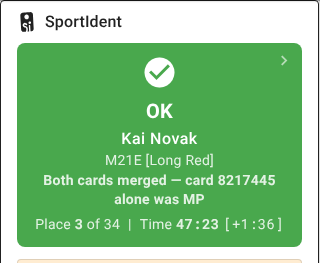
Both reads are now Kai's, and both rows in the list say OK, because each shows the runner's result:

What to do: nothing. His card number stays 8217445: reading the second card never changes either card. If the mis-punch splits print was still waiting to print, the OK one prints in its place.
Which card to read
Read the runner's first card, the one they're entered on. If it's OK, that's their result and they're done. Only if it's a Missing punch, read their second card as well, and let it fill the gap.
Why not read both every time? Reading a card takes time, and at a busy finish every read is somebody else waiting in the queue. For almost every runner both cards worked, so reading the second card too would slow the queue down to change nothing.
It doesn't matter if a runner gets it the other way round. If they put their second card in first, it's matched to them and gives their result on its own; reading their first card afterwards is fine, and so is not reading it at all. If both cards are read and both worked, the second read changes nothing in the result: the panel shows the same result again, with the line Both cards merged — card … alone was OK. Their time comes from the first card, and no second splits print comes out: a read that changes nothing prints nothing.
What to do: nothing beyond reading both. Each card shows in the downloads list with the runner's name.
Only the second card comes back
If the first card was lost, or left at home after the race, read the second one. It's matched to the runner by its number, and the panel shows their result as it would for their first card.
What to do: nothing. The result stands on the second card's times. If the first card turns up later and is read, it joins the second, and the result is worked out from both.
Each card missed a different control
Sometimes neither card has everything. Wilhelm Norton's first card has no punch at control 31, and his second has none at control 101. Each read on its own is a Missing punch. Read together, though, the two cards have every control, so once the second is read he's OK:
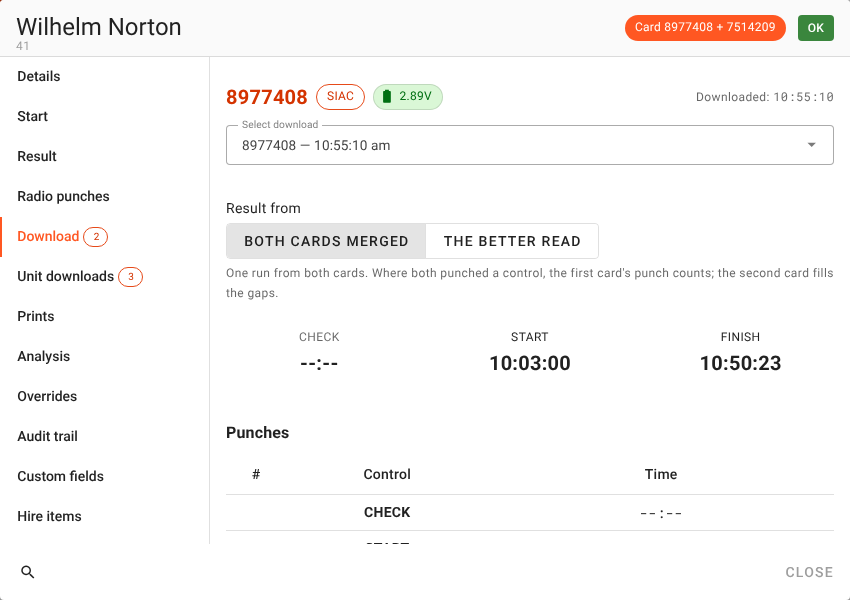
What to do: decide whether that's what your event wants. By default meshO combines the two cards into one run, which is how most organisers think of a backup card. If your rules say each card has to stand on its own, change it for that runner (next section).
Choosing how the result is worked out
Open the competitor and go to Download. Once reads of both cards are held, Result from appears, with two choices:
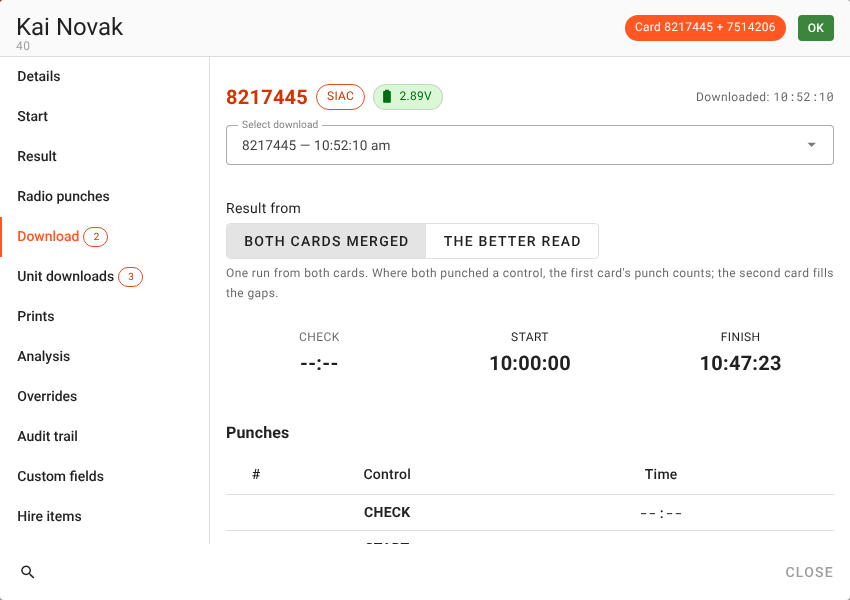
- Both cards merged (the default). One run from both cards. Where both punched a control, the first card's punch counts; the second card fills the gaps.
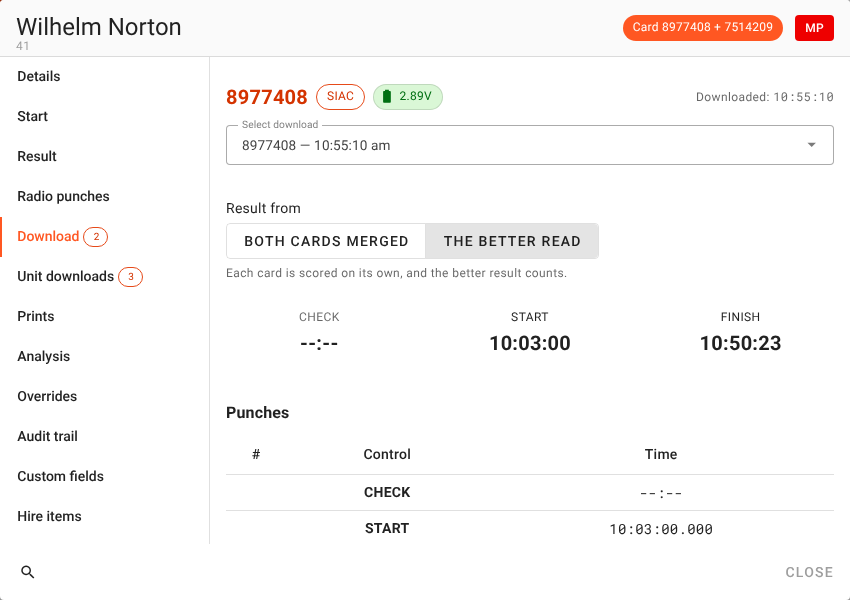
- The better read. Each card is scored on its own, and the better result counts. If they score the same, the first card counts. When a card is read, the panel says which one was used, such as Second card used — first card 8217445 was MP, or Not used — their other card 7514206 is OK for a read that doesn't count.
Switching takes effect straight away. For Wilhelm, The better read makes him a Missing punch, because neither card on its own has every control:
What to do: leave it on Both cards merged unless your event's rules say otherwise. The choice is per runner, and you can switch back at any time.
The Select download picker above it only changes which read you're looking at. It doesn't change the result.
Taking a read off a runner
- Unassign one read (from the downloads list, as for any read) and the other stays. The runner's result then comes from the read that's left.
- Take the second card off the runner (the card button, then Remove) and its read goes with it, waiting in the list to be assigned. The result comes from the first card alone.
- Assign a read of their other card by hand, and meshO holds it beside the one they have. It doesn't ask whether to replace their result, because nothing is replaced.
A second read of the same card is different: that's the card being used again, and meshO asks what to do, as it would for anyone (see Card already used).
When something doesn't look right
The second card came up as an unknown card. It wasn't recorded on the runner when it was read. Record it now (see Recording the second card). If the runner already has their first card's read, the waiting read of the second card is picked up as soon as you save. If they don't, assign it to them from the downloads list.
"Card … is already held by "…", so it cannot be a second card." Two entries can't share a card. Check which runner it really belongs to, and take it off the other one first.
The result didn't change after the second card was read. Both cards probably missed the same control. Open Download, switch between the two reads with Select download, and compare their punches.
How the merge works
For readers who want the detail.
- The first card is the record. It's the card the runner is entered on, whichever was read first. Their start, finish and check come from it when it has them, and from the second card only when it doesn't.
- A punch on both cards counts once. When both cards punched the same control within 30 seconds of each other, the first card's punch is used. A second-card punch of a control the first card doesn't have fills the gap.
- Radio punches follow the same rule. Radio punches from either card are the runner's, and where both cards punched the same control, the first card's time is used. So the live results and the downloaded result agree.
- The merged run isn't stored. Both reads are kept exactly as they were read, and the result is worked out from them each time. Changing Result from, a course, or an override recalculates it.