
Appearance
Safety check: accounting for everyone
Audience: Timing operators and event organisers making sure nobody is left out on the course at the end of the day.
The single most important thing timing does for participant safety is answer one question: is everyone back? Before search-and-rescue is even a thought, the timing system is the first place anyone looks to see who is still out. This page explains how Manager tracks who is On Course, where to view who still hasn't returned, how radio punches and card/station downloads move people in and out of On Course, and how to manually correct the picture when the automatic rules get it wrong.
Manager uses the term On Course in the UI. This is the same as In Forest in other event systems. This page uses On Course throughout.
The short version
At the end of the event, you want the On Course count to be zero — every competitor either has a result (finished, MP, DNF, …) or has been explicitly marked DNS because they never started. Anyone still showing On Course is, as far as Manager knows, still out on the course.
A safe wrap-up is therefore:
- Open the dashboard and look at the Competitors tile. If On Course is not zero, click it.
- Work down the On Course list — for each person, confirm they're genuinely still out, have already finished (and just need a download or a manual nudge), or never started (mark them DNS).
- Don't power anything down until that list is empty and you're confident every remaining name has been physically accounted for by the organisers — not just by the computer.
The rest of this page explains each step and the things that can mislead you.
What "On Course" actually means
A competitor is On Course when Manager has evidence they started but no evidence they finished. They get there one of several ways:
- Their allocated start time passed. A background timer moves anyone with status None and an allocated start time to On Course once that start time is reached — even if there's no radio start punch. This is deliberate: it means people show as out on the course even at events with no start radio.
- A radio start punch arrived. A start punch from a radio control moves them to On Course and sets their start time from the punch.
- Any radio control punch arrived. A punch at a normal radio control (or a check punch) also moves them to On Course — Manager now knows they're physically out there, even if it missed the start.
They leave On Course when a result appears: a radio finish punch (→ provisional OK, see below), or a card download (→ OK, MP or DNF), or a manual status set by you.
Important caveat about the auto-start transition: because a passed allocated start time alone is enough to flag someone On Course, your On Course list at the end of the day will normally include every no-show who had a start time but never actually turned up. Those people are not a safety problem — but you can't tell them apart from genuine missing runners just by looking. Clearing the no-shows (see Marking no-shows as DNS) is what makes the remaining list meaningful.
The full set of rules behind every status is in Status and race time rules.
Radio starts and finishes
If your event has radio controls at the start and finish, they do a lot of the safety bookkeeping for you in real time:
- A radio start and/or check punch flips a competitor to On Course during the start procedure — using a radio on check is ideal for allocated starts and a radio on check and/or start is ideal for punching starts.
- A radio finish punch flips them to OK the moment they cross the finish — before they reach the download tent. This is the key point for safety: a radio finish is proof the person has returned, even though their card hasn't been read yet.
So at a well-instrumented event, the On Course count tracks the real field closely all day, and the dashboard graph of "On Course over time" rises through the start window and falls as people finish.
What radios don't guarantee:
- Not every event has start/finish radios, and not every control is a radio control. Where there's no radio coverage, people only move to On Course via the allocated-start timer, and only leave it when their card is downloaded. Plan your safety check around what's actually instrumented.
- Radio punches are not 100% (out of battery, out of range, or other anomoly). As an extra precaution, also download the start/check/finish units station memory to confirm.
Recommended start / finish hardware
How you configure the start, finish and check units has a direct bearing on how reliable your safety picture is.
- Use SRR units (e.g. BSF8-SRR or BSF9-SRR) for the start, finish and check. These capture every punch — both manual (contact) and contactless (SIAC "air") — and, being radio-reporting units, broadcast them to Manager via a meshO Control as radio punches as they happen. That keeps the live On Course count accurate without waiting for downloads.
- Don't make the start a Beacon Start — require a punch. Contactless "air" punching is very confusing for competitors, so it should not be used for the start: a beacon start fires when the competitor is in proximity instead of a deliberate action.
- A Beacon Finish is fine. Air punching at the finish is common and convenient. With an SRR finish unit you'll get radio finish punches for both SIAC (air) and manual punches, so contactless runners still flip out of On Course the moment they cross the line.
In short: contact punch at the start, beacon allowed at the finish so nothing is lost whichever way a runner punches. Requiring a manual start and/or check punch makes reading the station backups definitive - all competitors are recorded. Note that SIAC punches are never recorded by the SportIdent station as that's a limitation of the technology.
"OK" but not downloaded (provisional OK)
When a competitor gets a radio finish punch but hasn't yet downloaded their card, Manager marks them OK but flags the result as provisional. In the UI this shows as OK* — an orange-outlined chip, and on results/leaderboards the time carries a * and is shown in italics with no medal.
For the safety check, provisional OK counts as "accounted for" — a finish punch means the person is back from their course. But it is not a finished result yet:
- A provisional time is never published as a result. An exported or uploaded results file (IOF XML, Eventor) still lists the competitor, but with the status overridden to DNF and no time — the card hasn't been read, so nothing confirms they completed the course. See What an exported results file contains.
- The provisional OK is replaced by the real result when the card is downloaded — which may turn out to be OK, MP or DNF.
So OK* people are safe but unfinished business: chase them to the download tent so you get a real result. You can list them quickly — the Status filter on the competitor list has a dedicated "OK (not downloaded)" option that sits right next to OK.
Reading SportIdent stations
When radios let you down — a finish radio missed people, a control stopped reporting, or you simply want to prove who came through somewhere — read the station's own internal memory using Station Memory. Every control unit keeps a backup of every manual punch.
This is the authoritative safety net for the "is everyone back?" question:
- Finish station — reading the finish unit's backup tells you exactly which cards manually punched the finish. Anyone in the finish backup is out of the forest.
- Start station — reading the start unit's backup tells you who actually started. Cross-reference against your On Course list: a name that's On Course but absent from the start backup probably never started (a no-show), not a missing runner.
- Check station — the check unit catches people who checked in near the start; useful corroboration that someone was present and heading out and very useful for allocated starts.
The Station Memory view auto-detects the station's mode and labels it (START / CHECK / FINISH, or the resolved control name for ordinary controls). Recovered punches that duplicate radio punches Manager already has are reconciled rather than double-counted. See Station Memory for the full read-out procedure and hardware notes.
Applying station records also changes status
Reading a station's memory is not just informational — when you apply the recovered records (select them and confirm), Manager records each as an independent station download on the matching competitor and updates their status, which directly moves people in and out of the On Course count:
- Start or Check station → puts a competitor On Course. A competitor who hadn't started yet (status None) is promoted to On Course — the punch is proof they went out. Someone already On Course or already finished keeps their status, and the start/check download never overrides an allocated start time or race time.
- Finish station → takes a competitor off course. An On Course competitor is marked DNF (Did Not Finish) — they came back, so they're accounted for and drop out of the On Course count, but a finish-station read alone gives no verified result (there are no splits to check). To turn that into a real result, download their card. A competitor who never started (None) is left alone — a stray finish punch won't DNF a non-starter — and anyone with a final result already (a real OK/MP/etc.) is unchanged.
A few practical points:
- Applying is idempotent — a record already recorded on a competitor is skipped, so you can safely re-read and re-apply a station.
- For unmatched cards (no competitor has that card number), a Start or Check read can create an Unknown On-Course competitor on the spot; unmatched Finish cards are listed for information only and are never auto-created (an unknown finisher carries no lost-in-forest risk to chase).
- This is exactly why the finish station is the strongest tool for clearing the On Course list at the end of the day: reading it sweeps everyone who came back but missed their finish punch into DNF, leaving only the people genuinely unaccounted for.
Course closure: settling the list at a set time
Most events declare a course closure — the time of day everyone has to be back — and Manager can act on it. Set it in Edit event → Details → Course closure (it is off unless you set it).
When that time of day arrives, Manager settles the entries nobody has accounted for, so the event stops claiming results it cannot produce:
| Where they were | Where course closure puts them |
|---|---|
| On Course | Overtime — they went out and are not back |
| On Course, still waiting in a relay changeover pen | DNS — they were never handed the map, so they never started |
| No status at all | DNS — nobody started them and the course is shut |
Provisional OK* (radio finish, card not read) | DNF, keeping the time and the * — the card is still to be read |
It also scores a card downloaded afterwards as Overtime rather than OK, when the card's finish punch was at or after the closure — the runner got round, just not by the time you set. Only a clean OK is affected; a mis-punch stays MP. Both this and the sweep above are worked out rather than stored, so fixing a mis-typed closure time re-scores everybody, and you can set any competitor back to OK by hand and have it stick.
Two things it deliberately does not do, and they are the ones that matter for safety:
- It does not decide anyone is accounted for. A runner marked Overtime with no time and no finish behind them is still on the On Course list, still in the dashboard's On course count, and still in the class list's column — because nobody has seen them. The status changed; the safety picture did not. This is true of an Overtime you set by hand as well: marking a late runner Overtime is a call about their result, not a report that they are back. They leave those lists when something says they are: a race time, a radio finish punch, a downloaded card, or a finish read out of the finish station's memory. Likewise the
OK*runners the closure moved to DNF stay on the Pending list and the download tent's screen until their card is read. - It does not overrule you. Any status you set by hand is yours, and course closure — the sweep and the download rule alike — leaves it alone.
So course closure does not replace the safety pass below; it does the bookkeeping half of it — the no-shows, the un-downloaded finishers and the late results — and leaves you the names that need a person to answer for them.
Where to see who is still out
Manager surfaces the On Course picture in several places. The two below are the ones the safety check itself is run from; every other place it shows up — the competitor and class lists, the Results view, the public screens, the download tent's own info screen — is collected in Seeing who is still on course.
The dashboard Competitors tile
The Competitors tile on the event dashboard shows the running totals — Total, Started, On Course, Pending and Finished — plus a graph of how many people have been On Course over the course of the day. The On Course figure is the headline safety number, highlighted in orange; it and Pending are drawn as buttons, because clicking them opens the list behind each.
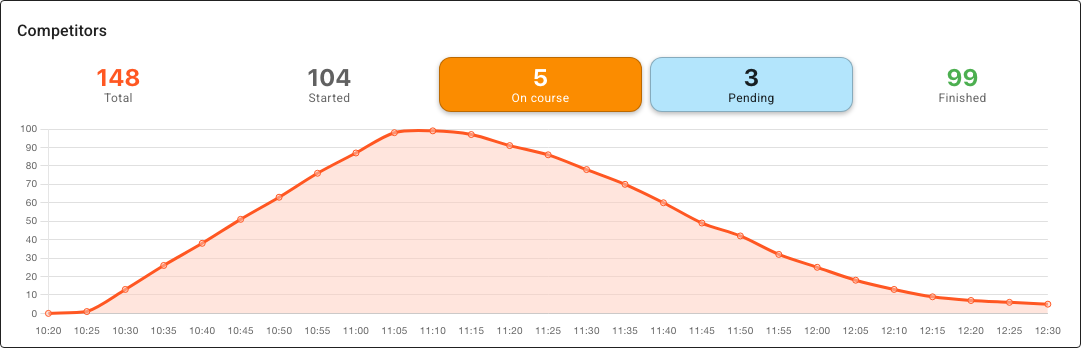
It includes both:
- competitors whose status is On Course, and
- cards no entry accounts for — radio activity, with no finish punch seen, from a card that nobody entered in the event can still be out on. That is a card matched to no competitor at all, and also a competitor out on a second course whose first run has already finished and downloaded. Either way somebody is out there, so they're counted too. See More than one run on a card.
The "On Course" dialog (click the tile)
When the On Course count is above zero, the number becomes clickable. Clicking it opens the On Course dialog — the single most useful screen for the safety check. It lists everyone still out, with:
- Name — click it to jump straight to that competitor's information. A card no entry accounts for shows in italics: Unknown, or the runner's name and which run this is (Jordan Blake, run 2).
- Card number — their card number.
- Class and Start time.
- Elapsed — how long they have been out, ticking up as you watch. It is measured from their start time against the event clock, so it reads
--:--when the event is no longer running, and for anyone Manager has no start time for. Sort on it when the question is who has been out too long rather than who has not been seen. - Last Seen — the last radio control they punched and when (e.g.
31 @ 11:03:18),STARTwhere they have punched nothing since starting, or-if no radio punch has ever been seen for them. The chip shows the control's code, or the radio's name if you gave it one.
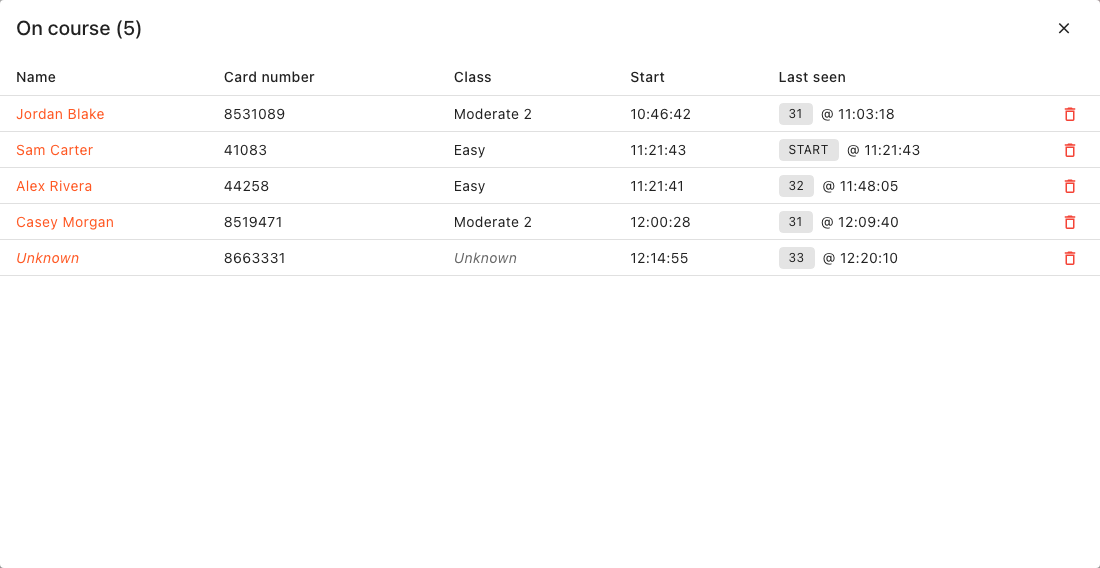
Read the Last Seen column in the example above and the list sorts itself into jobs. Jordan Blake punched control 31 at 11:03 and has not been seen since, which is why he is at the top even though three people started after him — the sort is on when somebody was last seen, not on when they started. Sam Carter shows START: he punched the start and no control since, which is the least Manager can know about somebody who is out there. The bottom row is an Unknown card (SI 8663331) that is out on the course but isn't matched to any competitor.
The list is sorted so the people seen longest ago (or never) are at the top — i.e. the most concerning names surface first. Cards no entry accounts for appear as italic rows with whatever start/last-seen radio activity that run has.
Each row also has a delete radio punches action (the trash icon). Use this only to remove genuinely spurious punches — for example a phantom or mis-read punch that's keeping a card showing as still-out. Deleting punches is permanent and re-evaluates the affected competitor from their remaining punches.
Everywhere else
The Competitors page's Status filter (which offers both On Course and the OK (not downloaded) option described above), the Classes page's per-class On Course column (whose count opens this same dialog for that class), the Results view, the public screens and the download tent's Pending downloads screen all show a slice of the same picture. They are covered, with screenshots, in Seeing who is still on course.
Marking people on course or not
Sometimes the automatic picture is wrong and you need to set it by hand.
Manually setting a competitor's status
Open a competitor (from any list, or from the On Course dialog) to reach the Edit Competitor dialog, then use the Status dropdown. You can set On Course directly (to mark someone as out when Manager didn't catch it), or move them off the course by setting a finished status (OK, MP, DNF, DSQ, OOC, Overtime) or DNS.
A couple of rules the dialog enforces:
- You can't set OK unless the competitor has a running time (an existing result, or one you enter). There's nothing to rank otherwise.
- Resetting to None ("no result at all") is restricted. Manager only lets you clear a competitor back to None when there's no evidence they started or finished — no race time, no provisional radio result, no punched start, no Start/Check/Finish station read, no assigned card download, and no timed radio control visits. (An allocated start time alone doesn't count as evidence — that's the no-show case.) If real evidence exists, the dialog blocks the change and shows a "Can't set status to None" dialog listing the specific evidence (e.g. "a recorded race time (00:45:30)", "a downloaded card", "2 radio punches"). This guard exists so a genuine result is never quietly discarded by relabelling.
Marking no-shows as DNS (bulk)
The most common end-of-event correction is clearing out the no-shows that the auto-start timer flagged as On Course. Rather than editing each one, open the competitor list's Actions menu and choose Set competitors DNS. It lets you select classes and a status filter of None and/or On Course (no radio punches). When you include On Course, Manager only sweeps up people with no actual radio control visit times — so you can't accidentally DNS someone who genuinely started and was seen by a radio. That's exactly the set of "had a start time, never actually turned up" no-shows you want to clear.
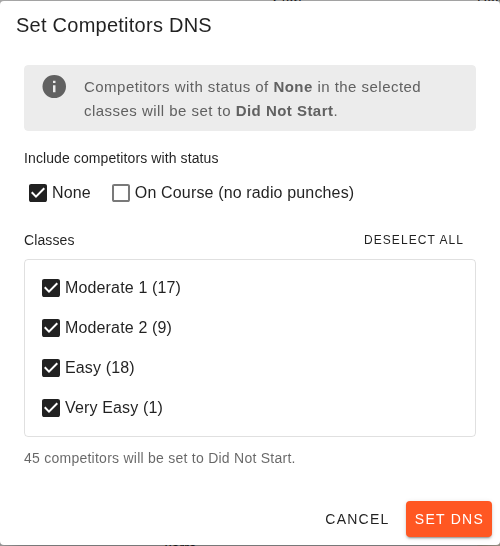
Each class shows how many competitors currently match, and the dialog totals how many will be set to Did Not Start before you confirm. Do this only once you're confident those people really didn't start — that's the judgement call Manager can't make for you.
Tip: To see the individual names first, click Not Started on the dashboard's Competitors tile. Anyone there with a blank status is a name nobody has accounted for; the ones already reading DNS have been cleared. See The Not started dialog.
Phantom radio punches keeping someone "on course"
If a stray or duplicated radio punch is wrongly holding a competitor (or unknown card) in the On Course bucket, you can suppress it. The Radio Times chips on the competitor list offer a suppress action for On Course competitors (when the event is using meshO Prime for radio punches); suppressing hides that punch from the Leaderboard and recalculates the competitor's predicted position without it. For an outright bad punch, the On Course dialog's per-row delete removes the radio punches entirely. See Radio punches and Resolving issues on the day for the detail.
A worked end-of-event safety pass
Putting it together, once the last expected competitor should be home:
- Dashboard → Competitors tile. Note the On Course count. If zero, you're done — confirm with the organisers and move on. (If you set a course closure, the no-shows have already been marked DNS for you — but everyone the count still holds is a name you have to answer for, whether Manager calls them On Course or Overtime.)
- Click On Course to open the dialog. Work top-down (longest-unseen first).
- For each name, decide:
- Genuinely still out → tell the organisers; this is the real safety case.
- Finished but no result (showing
OK*, or you know they came in) → download their card, or read the finish station memory to confirm, or set the status by hand. - Never started (no radio activity, not in the start station backup) → mark DNS, individually or via the bulk Set DNS dialog.
- Re-read start/finish stations to confirm the list against hardware truth, noting that beacon punches aren't recorded by stations.
- Recheck the On Course count is zero (and there are no leftover Unknown cards) before declaring everyone is back.
Then continue with the rest of the end-of-event checklist.