
Appearance
Printing splits
Audience: Organisers deciding what printing gear to bring, and timing operators running the download desk on the day.
This page covers what a printout contains, the two ways Manager can print one, how to choose between them (and how to run both), and what to do when nothing comes out.
Note: Everything here is about the printed slip. What a spectator sees on a phone or a TV is covered in Leaderboard and Event info screens.
What a printout contains
The whole slip is rendered by the server, whichever printer it eventually comes out of. That is worth knowing up front: it means every printer at your event produces exactly the same slip, and the settings that decide what goes on it live in one place rather than on each laptop.
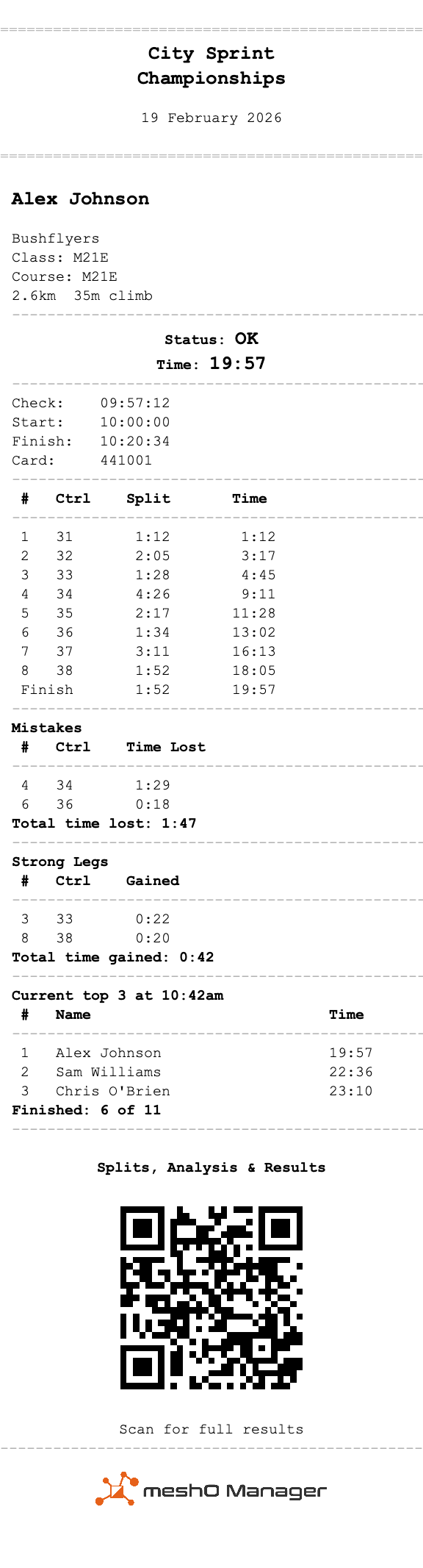
Reading down the slip:
| Section | What it says | When it appears |
|---|---|---|
| Header | Event name and date | Always |
| Competitor | Name, club, class, course, course length and climb | Always (club, class and course only when the competitor has them) |
| Result | Status and race time, in large type. Points and any penalty on a score course | Always |
| Timing | Check, start, finish, card number, and the SIAC battery voltage | Each line only when that time exists |
| Splits | One row per control: number, control code, leg time, elapsed time — then the finish row | When the card has been read |
| Extra controls | Punches that were not on the course | Only on a clean (OK) run that has some |
| Mistakes | The legs that cost time, and the total lost | When the analysis found time lost |
| Strong legs | The legs run best against the runner's own pace, and the total gained | When the analysis found at least one. At most five — the biggest, printed in course order |
| Class standings | The current top 3, the runner's own place if they finished outside it, and how much of the class has finished | When the Print top 3 places setting is on and someone has a place |
| QR code | A heading, the code, and a caption | When the QR code is switched on and has an address |
| Footer | The meshO logo, or the words meshO Manager | Always |
Four of those sections answer questions the operator would otherwise be asked at the desk. Mistakes heads off "where did I lose it?", strong legs heads off "did I do anything right?", class standings heads off "who won?", and the QR code heads off "where do I see the full results?".
Note: Strong legs is the mistakes analysis run the other way, against the same yardstick: the runner's own pace over the rest of their course, not the fastest split. That is deliberate — somebody half way down the field never has the fastest split on anything, so a comparison against the winner would hand most of your entrants a blank section at every event they ever run. Measured against themselves, they get told which control they nailed.
Only the five biggest fit, so a runner who ran well all day gets their best five and a heading that says Strong Legs (top 5). The total underneath still counts every one of them, which is why it can come to more than the five rows above it add up to.
Tip: The standings heading is what stops a runner reading a provisional top 3 as a final result: it says Current top 3 at 10:42am while anyone in the class could still displace those places, and Final top 3 once nobody can. Leave the section on.
Note: The line beneath the places — Finished: 6 of 11 — counts the runners who hold a place against everyone entered in the class. The two do not close the gap between them, and that is not an error: someone who mis-punched, retired, was disqualified, or was seen by the radio finish but has not downloaded yet is neither placed nor still out on the course. If you want to know who is actually still in the forest, that question is Safety check: accounting for everyone, not this line.
Paper width
Manager lays the slip out for the roll it is printing on: 80 mm (the standard width) or 58 mm. The narrow roll fits the same information into fewer columns, so lines wrap more and the slip comes out longer.

Paper width is set per printer, not per event — once in Settings for the printers the server prints on, and on each download station for its own (see below).
Language
The slip is printed in whichever language you choose in Splits language, independently of the language the operator's browser is in. Left as Same as display language it follows the installation's default language, so an installation that switches language switches its splits prints with it. An event can name a different language of its own, which is what an international event needs.
The two ways to print
Manager can print a slip from either end of the connection, and the difference matters when you are deciding what to buy and where to put it.
- The server's printers. One or more printers, attached to the computer running Manager or reachable on the network. Each is given a name — Left lane, Women's Elite, Public — and each download station picks the one it wants its slips to come out on. A station that picks nothing uses whichever printer is marked the default.
- A station's own printer. A USB thermal printer plugged into a download laptop, printed straight from that laptop's browser. Set up per station, in that browser.
Both print the same slip, because both ask the server to render it. The difference is only where the paper comes out — and, as a consequence, how the tent works.
Choosing your setup
One printer on the server
Everything prints in one place: next to the server, or wherever a network printer is parked.
| Advantages | Disadvantages |
|---|---|
| One printer to buy, configure, feed with paper and troubleshoot | The slip comes out where the printer is, not where the runner is, so the collection point needs someone at it — or a rack the slips can be left in |
| The download desk stays lean, and the queue keeps moving — see below | At peak, every lane's slips queue behind one printer, interleaved in whatever order downloads arrive |
| Any station can print, whatever browser or device it is running — including a tablet | If it jams or runs out, nothing prints anywhere until it is fixed |
| Set up once, in Settings, and it applies to every event on the server | A network printer needs a stable LAN and a fixed address to stay reachable |
| Nothing to configure on each download laptop, beyond naming which printer it prints on |
The layout this buys you. Because the printer doesn't have to sit at the desk, downloading and collecting become two separate queues. Reading a card takes a few seconds, so a runner downloads and moves on immediately, and picks their slip up from a table at the far end of the tent — away from the readers, where they can read it and compare times without holding anyone up. The download lanes themselves need less space and less equipment: a laptop and a reader, no printer, no cable, no spare rolls under the table. On a busy day that is often worth more than having the slip in hand at the desk.
Best for: club nights and smaller events, especially where the download laptop is the server — and equally, any event that would rather keep its download lanes clear and hand slips out at a separate collection table.
A printer at each download station
Each laptop drives the thermal printer plugged into it, and hands the slip straight over the desk.
| Advantages | Disadvantages |
|---|---|
| The slip comes out beside the runner who just downloaded — no fetching, no mixing up, nobody staffing a collection table | A printer, a cable and a paper supply per lane |
| Capacity scales with lanes: four desks print four slips at once | The runner stays at the desk until their slip appears, and often reads it there — so the lane moves at the speed of the printing, not the reading |
| Nothing has to be carried anywhere, which suits lanes spread across separate tents | Needs Chrome or Edge on that laptop — Firefox cannot drive a USB printer even though it can read cards |
| A printer failing takes out one lane, not the whole tent | Needs a secure connection on any laptop that is not the server (the same HTTPS setup card download already needs) |
| No server printer needed at all, so the server can live in a box under the table | Set up by hand on each station, and stored in that browser — a different browser, or a fresh profile, starts unset |
| Each station picks its own paper width | On Windows, a printer already claimed by its own Windows driver has to be released before the browser can use it |
| A station that prints for itself always prints on download; there is no per-station switch for that |
Best for: events with two or more download lanes where you want the slip handed over at the desk — and events whose lanes are spread out, or in separate tents, where a single collection table would mean carrying slips across the arena.
Both together
A printer on the server and printers on the busy stations is a supported combination, not a conflict — and it is what a larger event usually ends up with.
Manager keeps the two from fighting:
- A station that is printing for itself tells the server to skip its own printing for that download, so a slip is never printed twice.
- If that station's printer is switched on but not actually connected — unplugged, or the browser was reloaded and the printer not re-selected — the server prints instead, so a slip is never dropped.
| Advantages | Disadvantages |
|---|---|
| Fast lanes print their own; the server's printer covers everything else | Two kinds of printer to keep working, and two places to look when one doesn't |
| Automatic fallback if a station's printer drops out | An operator reprinting from a station prints on that station's printer, which may not be the one they are standing next to |
| A printer at the enquiries desk can reprint for anyone without a lane's laptop | |
| Lanes that need to keep moving can drop their own printer and fall back to the collection table, one switch at a time |
Best for: regional and national events, and anywhere there is a results or enquiries desk separate from the download lanes.
Tip: Whichever you choose, bring a spare roll and put it beside the printer. The most common "the printer has stopped" call at an event is an empty roll.
Setting up the server's printer
Open Settings → Splits printer. The top half of the page, Printer connection, is the printer — or printers — this server prints on.
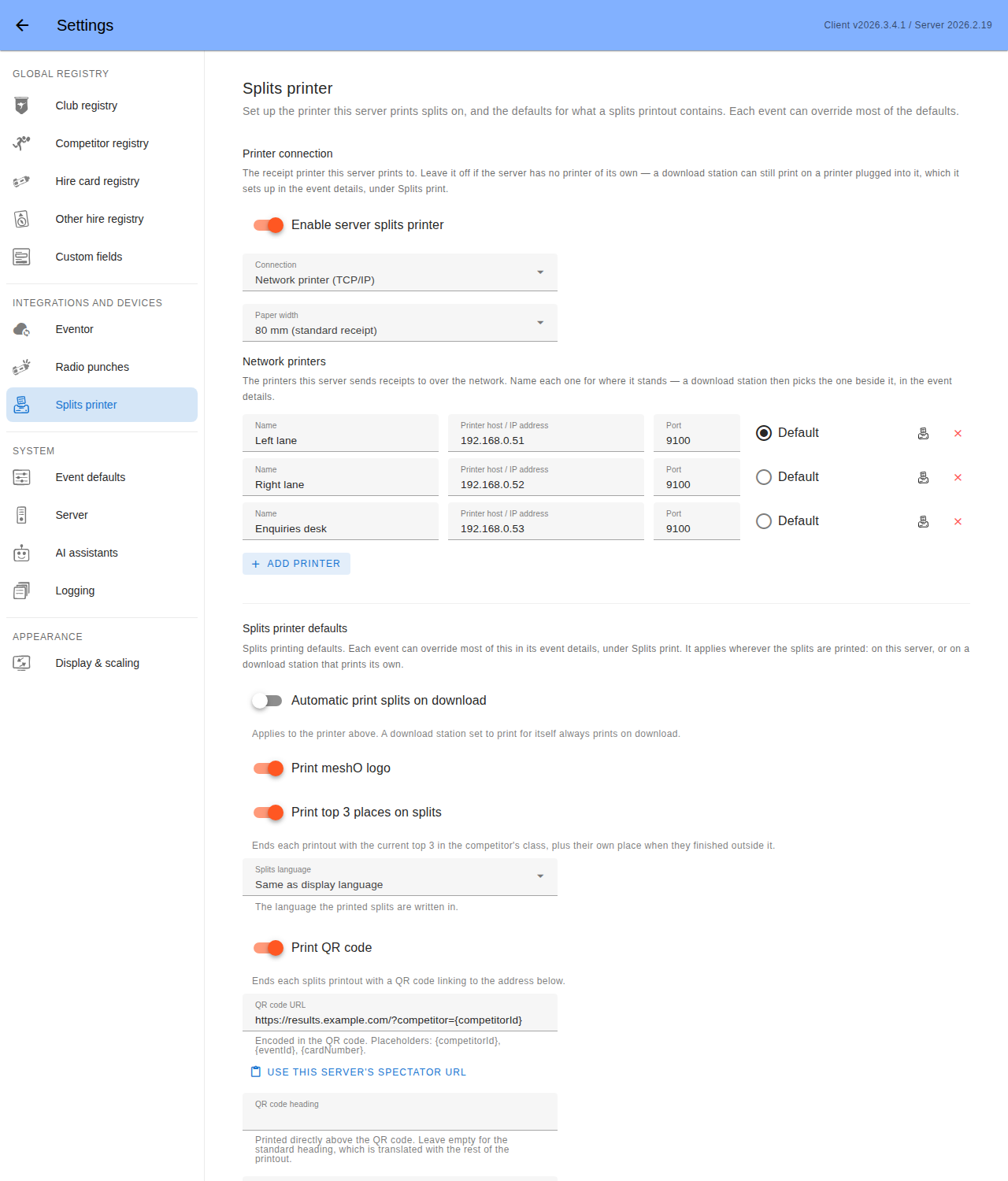
- Turn on Enable server splits printer.
- Choose the Connection:
- Network printer (TCP/IP) — for printers with their own network address, or a print server. This works whatever operating system the server runs, and you can list as many printers as you have (see below).
- Directly attached printer (USB — Windows) — for a printer plugged into the server itself. Windows only, and one printer.
- Set the Paper width to match the roll.
- Press Test print. A short test slip should come out; if it doesn't, the message under the button says what went wrong.
Listing your network printers
A network connection is a list, not a single address, because an event usually has more printers than servers: one per download lane, one at enquiries, one for the announcer.
Press Add printer and fill in the row:
- Name — what you call it. Use where it stands, not what it is: Left lane, Right lane, Women's Elite, Public. That name is what an operator picks from at their station, so Epson TM-T20III #2 helps nobody standing in a tent. Leave it blank and the address is used as the name.
- Printer host / IP address and Port — how to reach it. 9100 is the usual raw-printing port. A row with no address is dropped when you save.
- Default — exactly one printer is the default. It is where a slip goes when nothing says otherwise: a station that has not picked a printer, and any print that isn't made at a station.
- The printer button beside each row sends a test slip to that printer. Test each one as you name it — that is how you find out you have Left lane and Right lane the wrong way round while it still costs nothing.
Renaming a printer later is safe: the stations pointed at it stay pointed at it. Deleting one is not quite — a station still set to it falls back to the default printer, so its slips keep coming out, just not where that operator expects. Tell the lane, or re-point it.
Note: Naming several printers does not, on its own, change where anything prints. Every station keeps using the default until someone at that station picks another — see Choosing which printer a station prints on.
A printer attached to the server
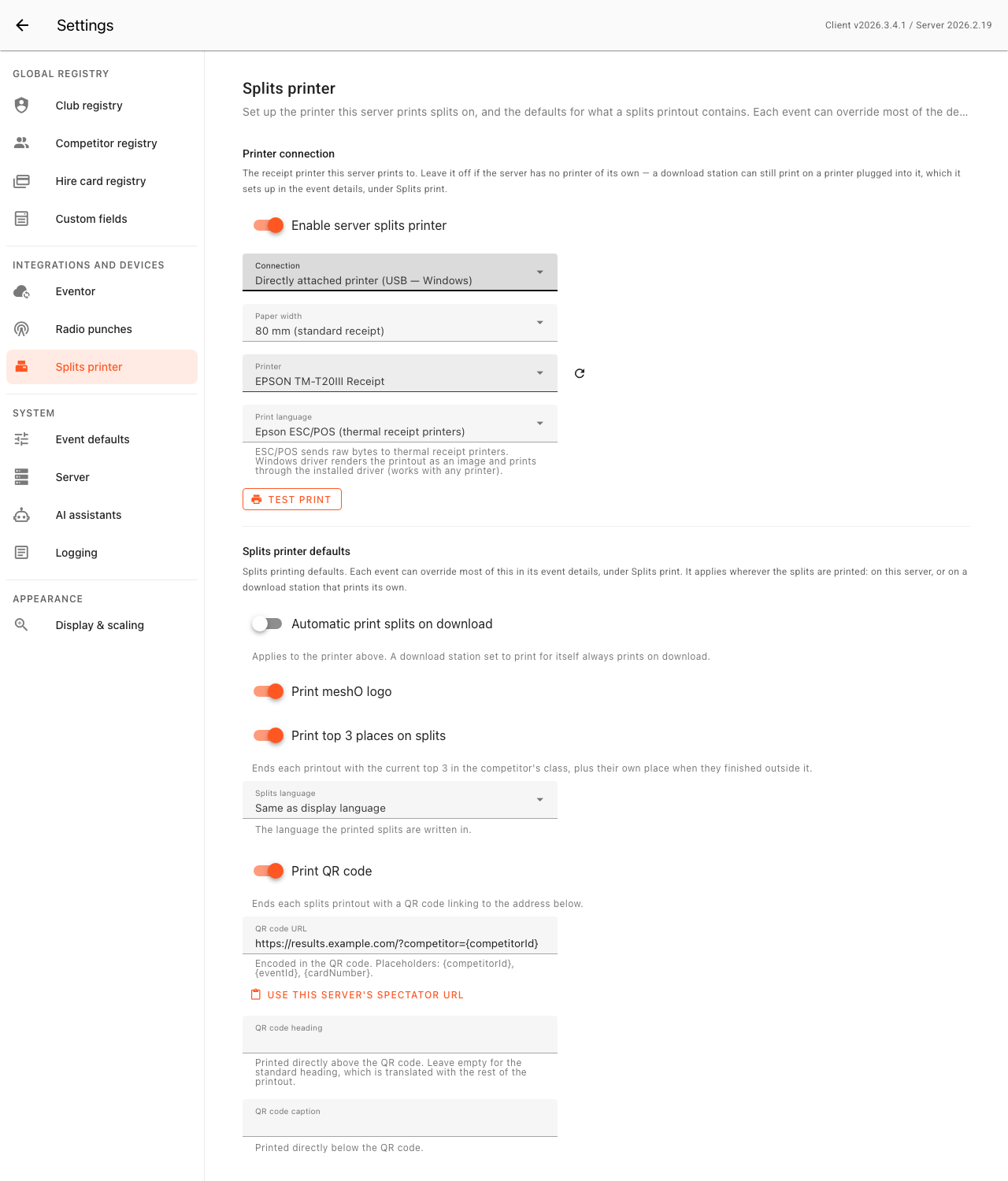
There is one of these, not a list — it is the printer plugged into the server itself. Choosing it adds two fields:
- Printer — the Windows printer to use. The refresh button beside it re-reads the list, for a printer plugged in after the page was opened.
- Print language — how the slip is sent:
- Epson ESC/POS sends raw thermal-printer commands. Use this for a thermal printer.
- Windows driver (any printer) renders the slip as an image and prints it through the installed driver. Slower, but it works with any printer Windows can print to — including an ordinary office printer, if that is what you have.
Choosing Windows driver adds two more, for a printer whose slips are coming out faint or patchy:
- Text size — how big the text is drawn, as a percentage of the usual size. Bigger text prints more clearly on a tired printer, and fits fewer characters on each line: the slip is drawn to the width of the roll whatever size it is set to, so the letters can only get bigger by there being fewer of them. At 150% on an 80 mm roll a long event name starts wrapping onto a second line; the splits table still fits. A 58 mm roll starts with fewer characters and so has far less to give — it offers one step up, and that is the whole of what fits.
- Print everything in bold — thicker strokes throughout. Worth trying on a printer that renders thin text patchily: a worn print head, or cheap paper. The cost is that the headings that are normally bold no longer stand out from the rest.
Use Test print after changing either. It prints at the size and weight you have picked, before you save them, so you can try a few and keep the one that reads best.
Neither reaches an ESC/POS printer — network or USB. That slip is printed in the printer's own built-in font, at the printer's own size, and nothing in meshO can change it. If an ESC/POS slip is coming out faint, the print density is a setting on the printer itself.
If the server has no printer
Leave Enable server splits printer off. The connection fields collapse, but the Splits printer defaults stay — because they are also what a download station's own printer prints from.
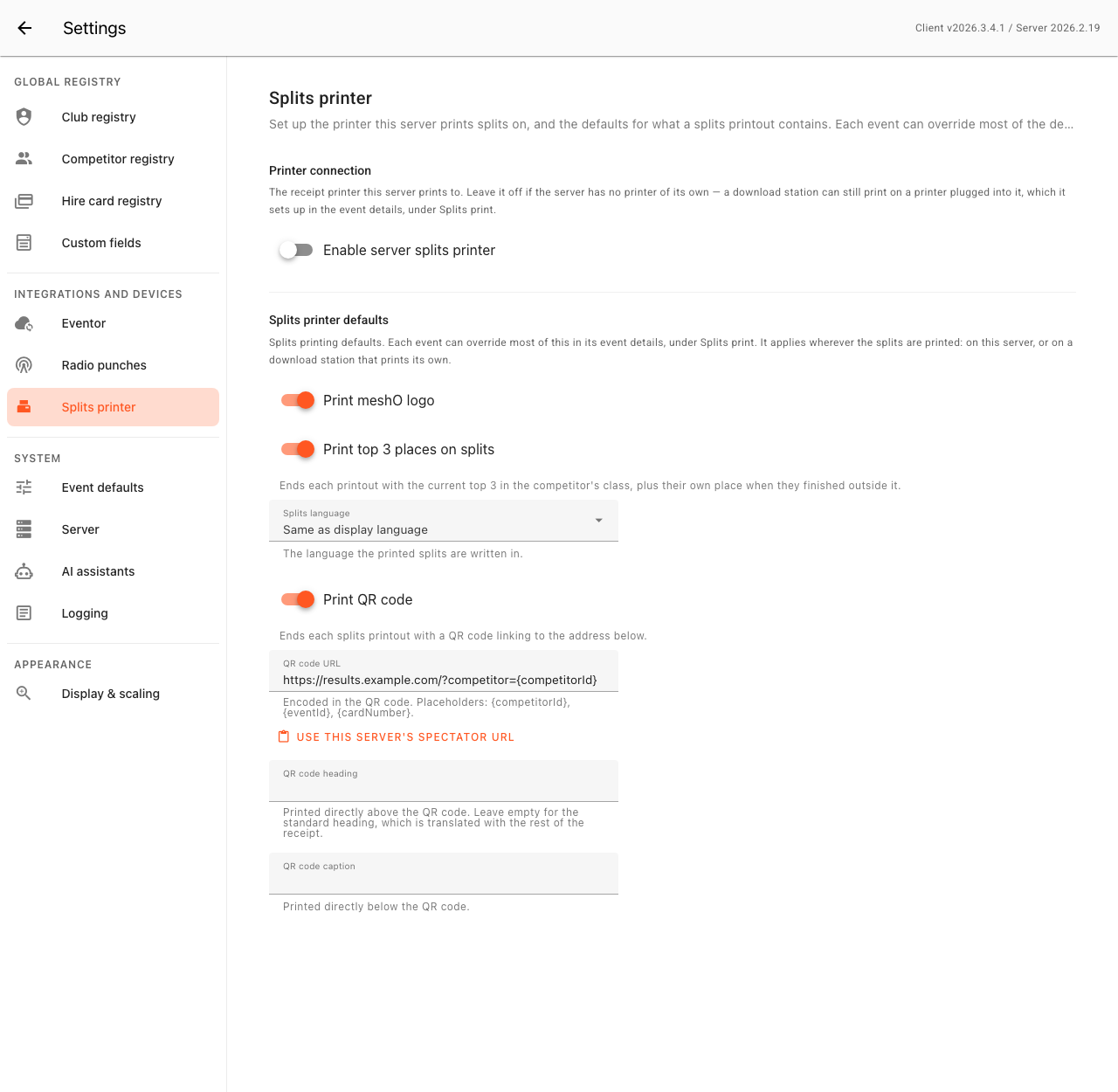
Every default stays, Automatic print splits on download included — it is not a property of a printer but you saying whether a download prints without being asked, and a station printing on its own obeys it exactly as the server's printer does. It used to be hidden here, which left a station-only desk with no way to say otherwise.
Choosing which printer a station prints on
Both of the station settings below live in Event details → Splits print, at the bottom of the tab, under Splits printing on this station. Both are set on the station, in that browser — not on the server, and not on the event. They apply to every event you open on that laptop, and they take effect the moment you change them, without saving the event.
If the server has more than one network printer, the station starts with a Print on dropdown:
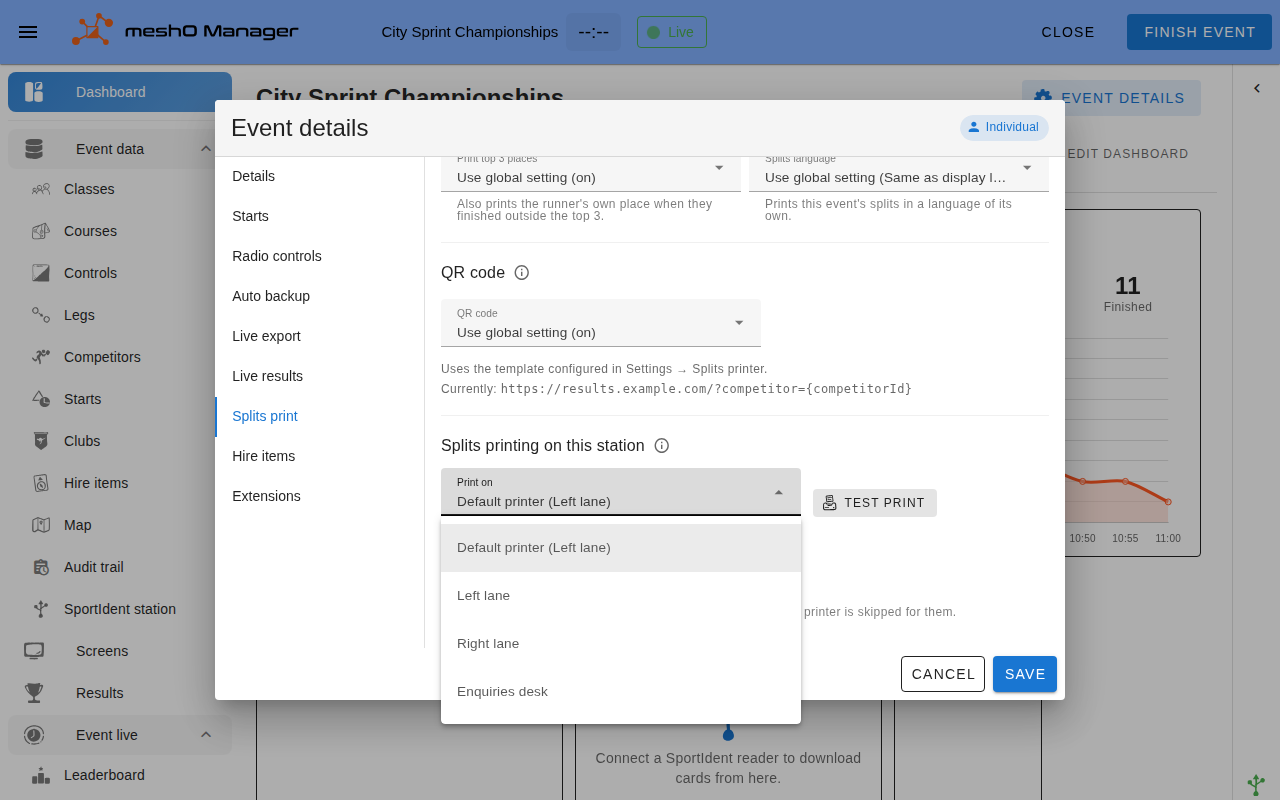
- Leave it on Default printer and this station's slips come out wherever the default is — which is what every station did before there were several to choose from.
- Pick a name and this station's slips come out there instead: its automatic prints on download, and anything an operator reprints from it.
- The printer button beside it sends a test slip to the printer you have picked. Use it: the point of the setting is that the slip lands beside the operator, and the only way to be sure is to watch one come out.
The dropdown is hidden when there is nothing to choose between — one network printer, or none.
Note: Each station makes this choice for itself, so two lanes sharing a laptop share a printer, and the same operator at a different laptop is set separately. If a lane's slips are coming out in the wrong tent, that lane's browser is where the setting is.
Setting up a printer on a download station
This one is set on the station too, and it lives in that browser — so do it at the laptop that has the printer.
Open the event, then Event details → Splits print, and scroll to Splits printing on this station.
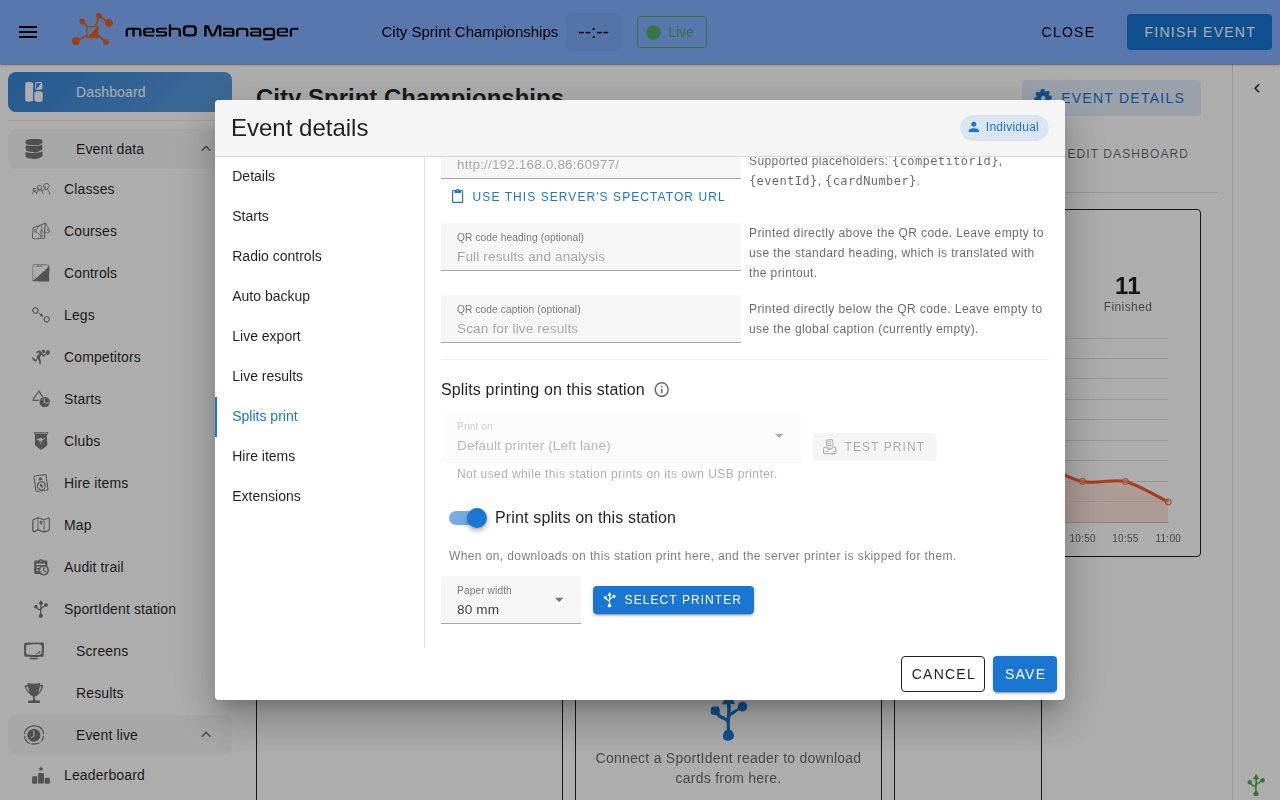
- Turn on Print splits on this station.
- Choose the Paper width for the roll in this printer.
- Press Select printer. The browser shows its USB device chooser — pick the printer and confirm.
- The button is replaced by a green Printer connected chip, a Test print button and a Disconnect button. Press Test print and check a slip comes out.
What to expect from this setting:
- It is remembered on this computer, in this browser, and applies to every event you open here — not just the one whose dialog you set it in.
- It does not affect anyone else. Other stations, and the server's own printers, are untouched.
- Downloads on this station print here automatically, and the server's printers are skipped for them — including whichever one Print on names, which is why that dropdown greys out while this switch is on.
- A reload needs one action to come back. The browser remembers which printer you chose, but the live connection to it does not survive a page reload. Opening Event details → Splits print re-establishes it silently, and so does a Test print — until then this station's downloads print on the server's printer instead, or, if there is no server printer, not at all.
Warning: That last point is the one to build a habit around. If you reload the page, or the laptop wakes from sleep and the page reloads with it, open Event details → Splits print once and check the green Printer connected chip is there before the next runner comes in.
Requirements, and the two things that usually block it
Printing to a USB printer from the browser uses the WebUSB API, which needs:
- Chrome or Edge. Firefox has the Web Serial API that card download needs, but not WebUSB — so a Firefox download station can read cards and cannot print on its own printer. Use Chrome or Edge on any laptop that is to have its own printer.
- A secure connection. On the computer running the server, opening Manager at
http://localhost:5154/manageris enough. On any other laptop, HTTPS has to be on and meshO's certificate trusted — the same one-off setup card download already requires. See HTTPS and certificates. If it isn't in place, the section says so instead of offering the printer.
The other blocker is Windows-specific and has a clear message: Windows is using this printer through its own driver, so the browser cannot claim it. If your thermal printer has been installed as a Windows printer, Windows holds it and will not let the browser take it. Remove the Windows driver for that printer (or switch it to WinUSB) and select it again.
Note: If you would rather not deal with any of that, the printer can be plugged into the server instead and shared with every station — that is the server printer setup above, and on Windows it can use the ordinary driver.
What each printout contains: the defaults
The lower half of Settings → Splits printer — Splits printer defaults — decides what goes on a printout, for every event on this server, on whichever printer prints it.
| Setting | What it does |
|---|---|
| Automatic print splits on download | A slip is printed for every download that produces a result, without anyone pressing anything. It governs whichever printer would print it — the server's, and a station printing on its own — so turning it off means no download prints by itself anywhere |
| Print meshO logo | The logo at the foot of the slip. Off prints the words meshO Manager instead |
| Print top 3 places on splits | Ends each slip with the current top 3 in the runner's class, plus their own place when they finished outside it |
| Splits language | The language the slip is printed in |
| Print QR code | Ends each slip with a QR code — see The QR code |
With auto-print off, nothing prints by itself at all: no slip, and no countdown on a mis-punch. Printing then happens only when you ask for it — see Printing by hand, and reprinting.
A slip is printed automatically for every result except one with nothing to say: an unknown or unassigned card, a repeat of a download already recorded, a card whose owner already has a result, and a competitor with no class. Mis-punches, DNFs and disqualifications all still print — a runner with a problem is exactly the one who wants the slip.
Mis-punches wait before they print
Most mis-punches at a download desk are not mis-punches. The runner went round a different course to the one they entered; you change their class, the download is re-evaluated, and the corrected slip prints. Which means the MP slip that came out the instant the card was read only ever went in the bin. Over a weekend that is a lot of paper.
So a mis-punch slip waits. Settings → Splits printer → Splits printer defaults has two controls for it: Hold a mis-punch printout, on by default, and Hold it for — 20 seconds by default, up to a minute. Switch the hold off and a mis-punch prints the moment the card is read, as every other verdict does. Both apply whichever printer the slip comes out of, so a station printing on its own USB printer counts down the same window as the server.
An event can take its own line on the hold, under Event details → Splits print → Hold a mis-punch printout — the usual three-way choice of Use global setting, On for this event, Off for this event. This is the one worth reaching for: whether the wait suits a desk depends on how that desk works. An event handing each runner their slip at the counter does not want twenty seconds of nothing between the beep and the paper; one correcting wrong-course entries all afternoon does. How long it waits is not overridable — that belongs to the desk, like paper width, not to the event.
While it waits, the result banner draws the window as an arc around a small printer icon, emptying as it closes. The arc only ever appears where a slip is actually coming and is actually waiting: with Automatic print splits on download off nothing prints by itself, and with the hold off the slip prints at once — either way there is nothing to wait for and nothing drawn. Both read the event's override before the installation's setting.
| What you do inside the window | What comes out |
|---|---|
| Change the class — or anything else that re-evaluates the download | The corrected slip, immediately. Nothing prints later than it used to; only the wasted sheet stops being printed |
| Press the ✕ beside the countdown, or open a dialog about that runner | Nothing at all — see below |
| Unassign or delete the download | Nothing. There is no longer a result for the slip to describe |
| Print the slip by hand | Your slip, once. The waiting copy is dropped rather than following it out |
| Nothing | The mis-punch slip, at the end of the window. A genuine mis-punch nobody touches still gets its slip |
Note: Changing the class to another one the punches also don't fit starts the window again — you haven't finished correcting yet.
Ending the wait with nothing printed
Sometimes there is nothing to correct: the runner really did miss a control, and the slip is a foregone conclusion you'd rather not wait for — or not print at all. The ✕ beside the countdown ends the wait there and then, and prints nothing.
Opening a dialog about that runner does the same. Clicking the banner to open their result, opening a download's detail dialog from the history table, clicking a name in that table, or opening the controls the dashboard tile dropped into a dialog — each ends that runner's wait. Opening them is you taking the correction in hand, and that is open-ended: reading the splits, choosing a class, thinking about it for a minute. A slip printing out from under you mid-edit is exactly the wasted sheet the wait exists to stop.
If the change you then make re-evaluates the download, the corrected slip prints as normal. If you close the dialog having changed nothing and you do want the mis-punch slip after all, print it with the printer button on that download's row — see Printing by hand, and reprinting.
The wait is per runner, not one at a time. Cards keep arriving while you work, and cancelling — or opening a dialog about — one runner never takes the slip of the next one, still standing at the desk waiting for theirs.
Note: Only mis-punches ever wait. Every other verdict prints exactly as it always did.
Per-event overrides
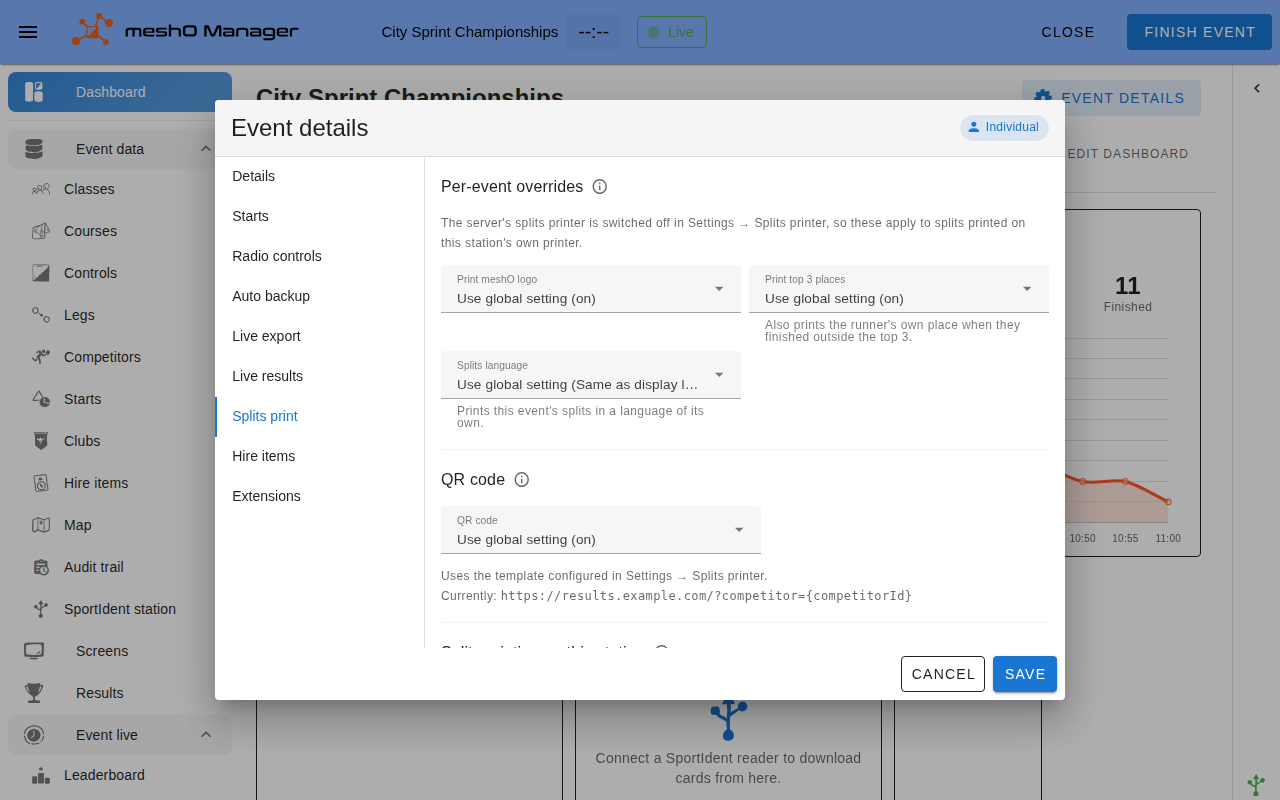
Most of those defaults can be overridden for a single event, under Event details → Splits print — including whether a mis-punch printout waits, covered in Mis-punches wait before they print above. This is where a low-key club night turns the QR code off, or an international event prints in a different language, without changing what every other event does.
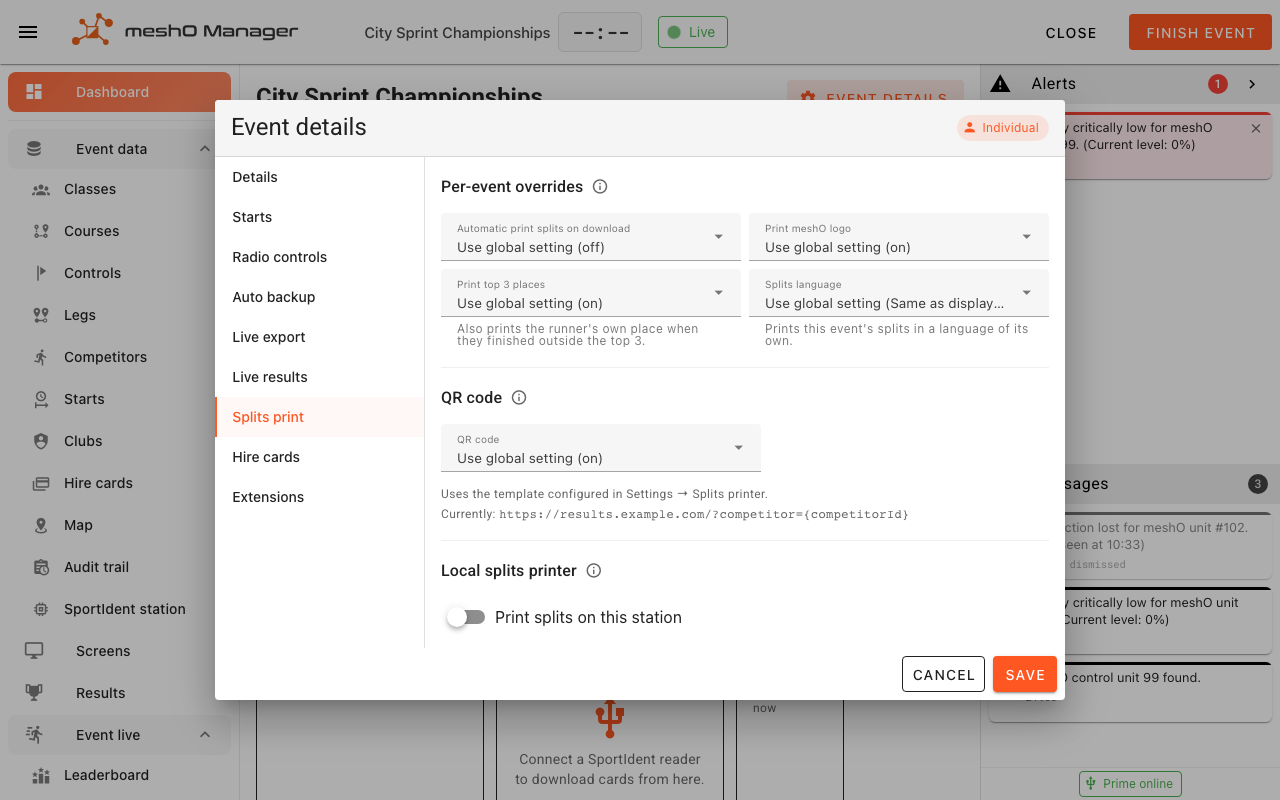
Each override is a three-way choice, and the first option names what the installation currently does — so you can see what you would be inheriting before you decide to override it:
- Use global setting (on/off) — follow Settings. Change the setting there later and this event follows.
- On for this event / Off for this event — this event goes its own way, whatever Settings says.
The QR code picker in the same tab works the same way but has more to say than on or off, so its middle option is Customise for this event — see The QR code.
Note: Paper width is deliberately not here. It belongs to a printer, not an event, so it is set on the server's printer and on each station.
When nothing is printing
If the server's printer is switched off and this station isn't printing either, the tab says so and holds the overrides back rather than letting you configure a printout nothing produces.
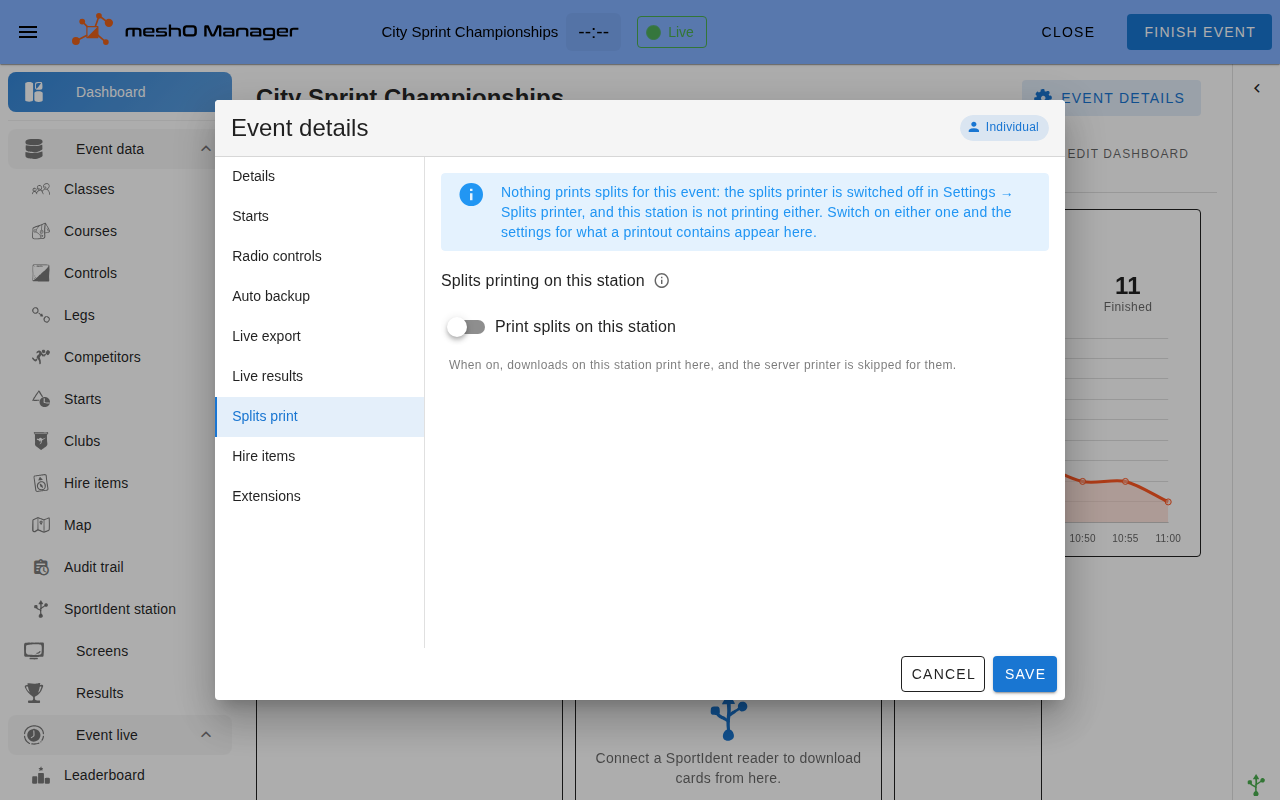
Turn on either one and the overrides appear. With only this station printing, they come back with a note saying the server's printer is off — the settings still apply, because the server still renders the slip.
The QR code
A QR code at the foot of the slip is the shortest route from a paper result to the full results on a phone. Scanned, it opens whatever address you configure — normally this server's own spectator page, with the competitor's id in it, so it lands on their result rather than the front page.
Four things make it up, and only the address has to be filled in:
| Field | What it is |
|---|---|
| Print QR code | The switch. Off prints no code, even with an address configured — so you can keep the address on file between events |
| QR code URL | What the code encodes. Placeholders {competitorId}, {eventId} and {cardNumber} are filled in per runner |
| QR code heading | The line printed above the code. Left empty, a standard heading is printed, translated with the rest of the slip |
| QR code caption | The line printed below the code. Left empty, nothing is printed there |
Use this server's spectator URL fills the address in for you, with the card number as the parameter. That is the right answer for most events; type your own address only if results are published somewhere else.
An event can take its own line on all of this. Under Event details → Splits print, the QR code picker offers:
- Use global setting (on/off) — what Settings says, with the installation's address spelled out underneath.
- Customise for this event — print a code, with this event's own address and wording.
- Disable for this event — no code on this event's slips, whatever Settings says.
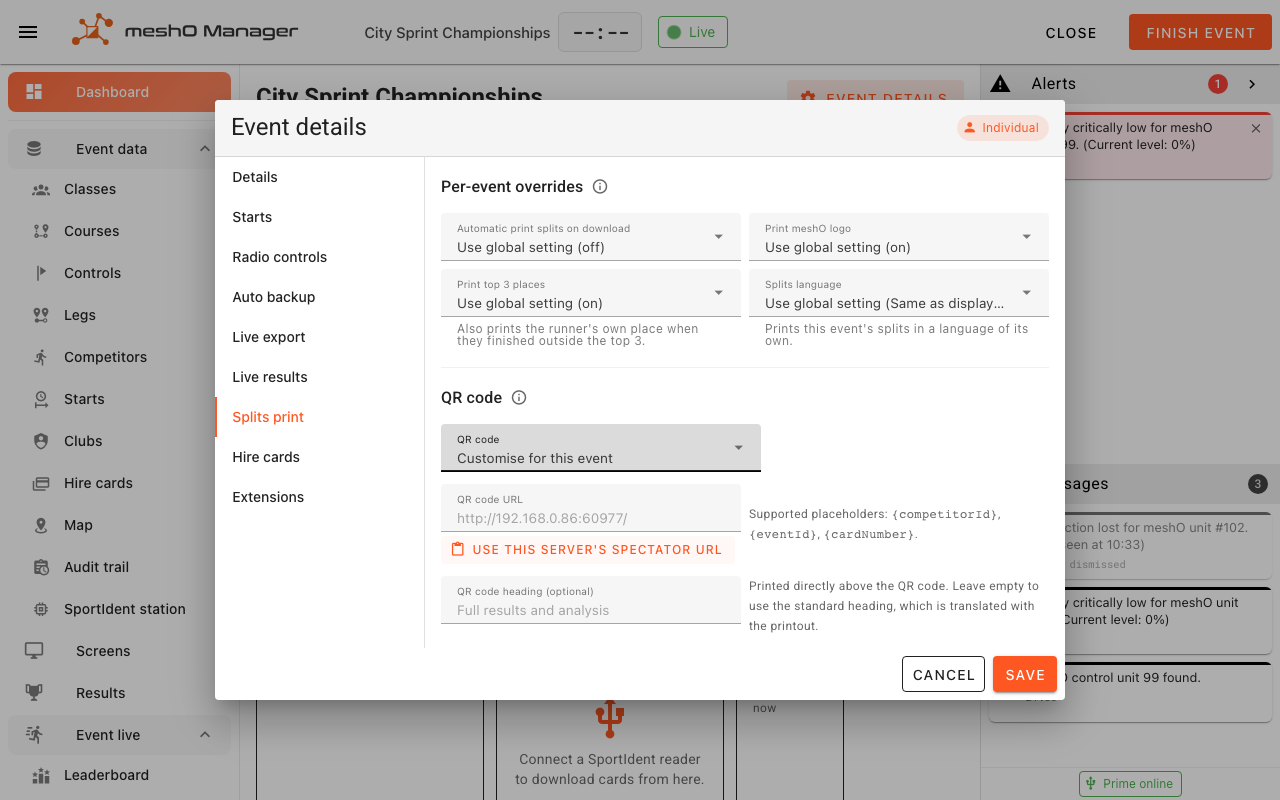
In Customise for this event, each of the three fields is independent: fill in only the heading and the event keeps the installation's address and caption. A field left empty inherits; it does not blank the line.
Tip: A custom heading is a good place for the club's or event's own words — Full results and analysis, or the name of the series. Leave it empty at an international event: the standard heading is translated with the rest of the slip, and your own words are not.
Printing by hand, and reprinting
Automatic printing covers the normal case. Two places print on demand — for a slip that jammed, a runner who came back for another copy, or an event that prints only on request.
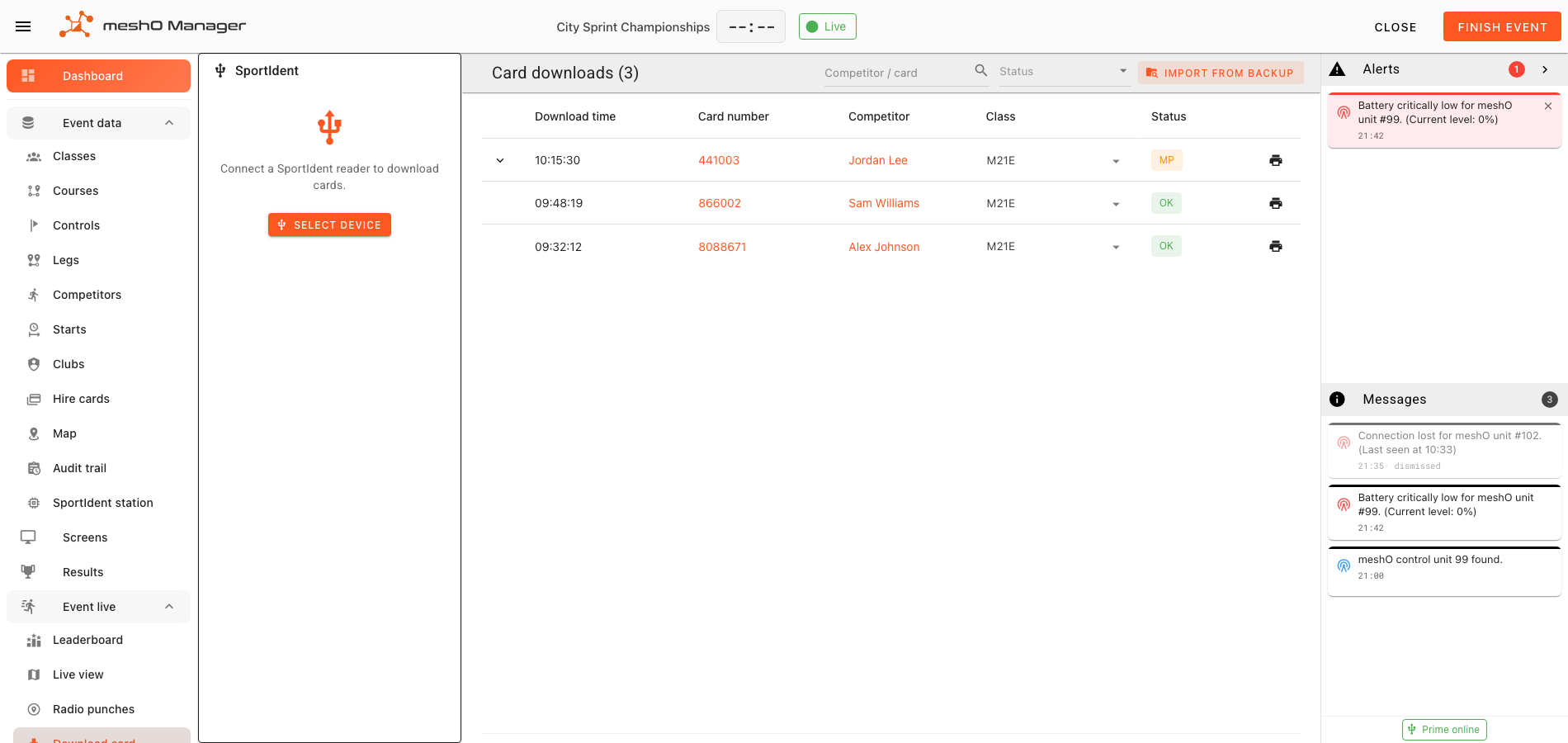
From the download history. Every row on the Download card page has a printer button that prints that download's slip.
From the competitor. Open a competitor and choose the Splits print tab. It shows the slip exactly as it would print, rendered by the server, with a Print button underneath.
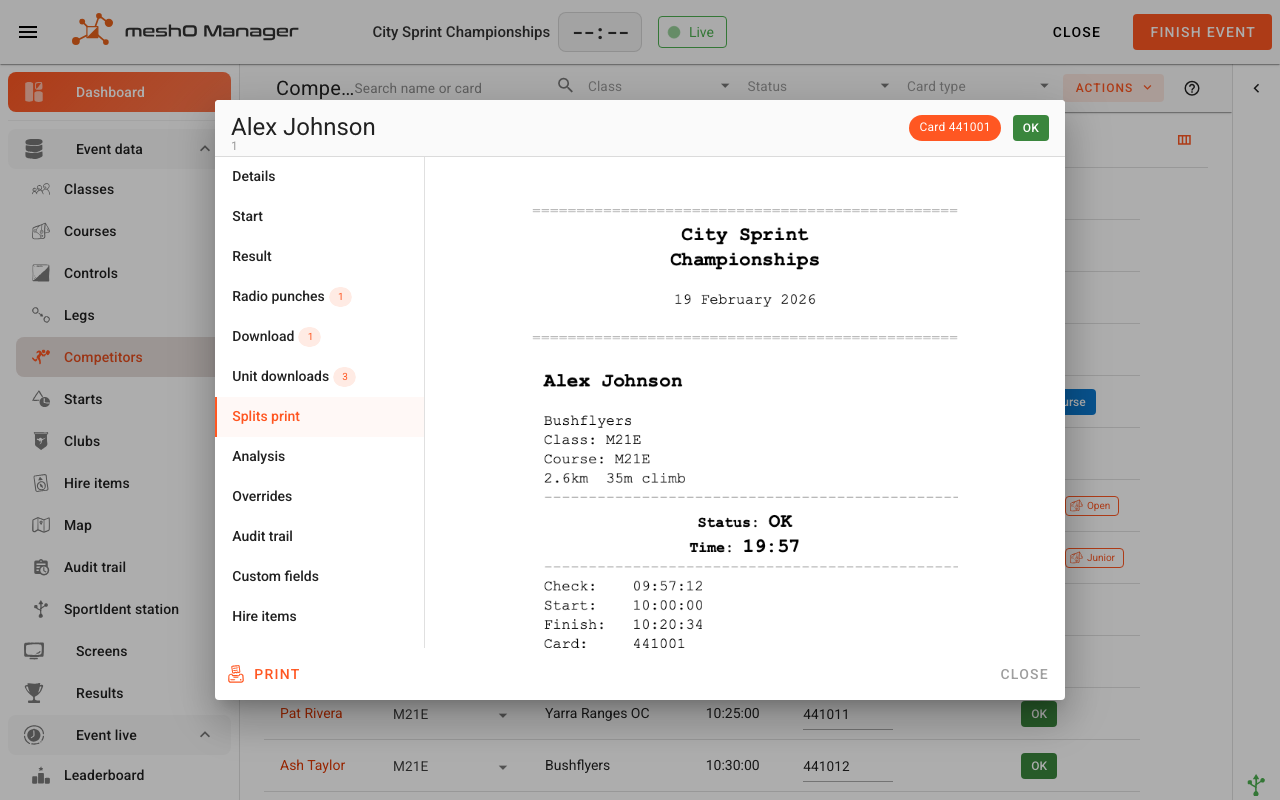
That preview is worth using while you set printing up: it shows the effect of every setting on this page — logo, top 3, language, QR code — without spending any paper.
Both buttons print on this station's printer if it is printing for itself, and on the server's printer otherwise.
Printing the results
The same printer will print the results, class by class — the sheet for the prize-giving table, or for whoever is reading the places out. On the Results page choose Publish → Print to splits printer.
The dialog asks what goes on the sheet, starting with the question you will change most often:
| Setting | What it does |
|---|---|
| Show | How many places per class. Top 3 to begin with — that is what the sheet is usually for. All prints everyone. Whatever you pick is printed at the top of the sheet, so nobody reads a Top 3 as a whole class |
| Group by, Classes / Courses, Organisation | The same filters as the Results page |
| Class sort order (the sort button beside Classes) | Opens the event's class order — the order the classes print in, and the order they appear in everywhere else. Changing it here redraws the preview |
| Include (the six tickboxes) | Unsettled classes — whether a class where somebody could still take a place appears at all. Leave it on to see everything; turn it off when you are printing a sheet to read out. On course, No status, DNS — whether those competitors are listed, exactly as on the Results page. Club and Behind — whether each gets a column. Club switches itself off when you filter to one organisation, since it would then be the same on every line; put it back if you want it. On a 58 mm roll there is no room for either, and they are dropped so the names stay readable. The i beside the heading says all of this in the dialog |
| Printer | Which printer it comes out of: the one plugged into this computer, or any of the server's |
The preview beside the settings is the sheet itself, drawn by the server — what you see is what comes out, so you can get it right before spending any paper.
A class where somebody could still change the places is marked with * beside its name, and the sheet explains the mark once at the bottom. That covers the case a list of finishers cannot: three runners home and placed, a fourth still in the forest. Competitors who have finished but whose card has not been downloaded yet are never listed as results, here or in any other Publish action.
Tip: The sheet is deliberately spare — a heading per class, then place, name, club abbreviation and time. A Top 3 of twenty classes is about a hand's length of paper.
When nothing prints
| What you see | What it usually is |
|---|---|
| No printer buttons anywhere | Nothing is set up to print: the server's printer is off and this station isn't printing either |
| Nothing prints on download, but printing by hand works | Automatic print splits on download is off — check Settings, and the event's own override |
| A station prints nothing, the server prints everything | The station's printer is switched on but not connected. Reconnect it with Select printer; the server has been covering for it |
| Two slips per runner | Two stations are set to print for the same downloads, or a slip is being printed by hand as well. A station that is properly connected suppresses the server automatically, so this points at a second station rather than at the server |
| This browser cannot use a USB printer | The station is on Firefox or Safari. Use Chrome or Edge |
| Needs a secure connection | HTTPS isn't set up on this laptop — see HTTPS and certificates |
| Windows is using this printer through its own driver | Remove the Windows driver for that printer, or switch it to WinUSB, then select it again |
| A message that the USB device does not look like a printer | The wrong device was picked in the chooser — try again and pick the printer |
| The test print fails with a connection error | For a network printer, check the address and port, and that it is on the same network. Most thermal printers print their own address if you hold the feed button while powering on |
| Slips print, but the layout is wrong | The paper width doesn't match the roll. Set it on the printer that printed the slip: Settings for the server's, the Splits print tab for a station's |
| A runner's slip is blank or missing sections | Sections appear only when there is something to say — a competitor with no class, or a card that has not been read, has nothing to print |
Related
- Downloading cards — the download that triggers a printout
- HTTPS and certificates — needed on any download station that prints on its own printer
- Settings reference — every settings page, including this one
- Resolving issues on the day — the wider on-the-day troubleshooting page
- Status and race time rules — what the status on the slip means
- Multi-operator setup — running more than one download station